CBD Oil vs CBD Cream: 7 Powerful Differences You Must Know Before Choosing
Compare CBD oil and CBD cream to understand absorption, real uses, legal history, and quality risks before you pick a product.
CBD oil vs CBD cream is one of the most common questions people ask once they decide to try cannabidiol for the first time, and honestly, it’s a fair question. Walk into any pharmacy, wellness shop, or gas station these days and you’ll find shelves packed with tinctures, roll-ons, balms, and jars promising relief from everything from sore joints to anxious thoughts. The problem is that most of these products look similar on the label but work in completely different ways once they touch your body.
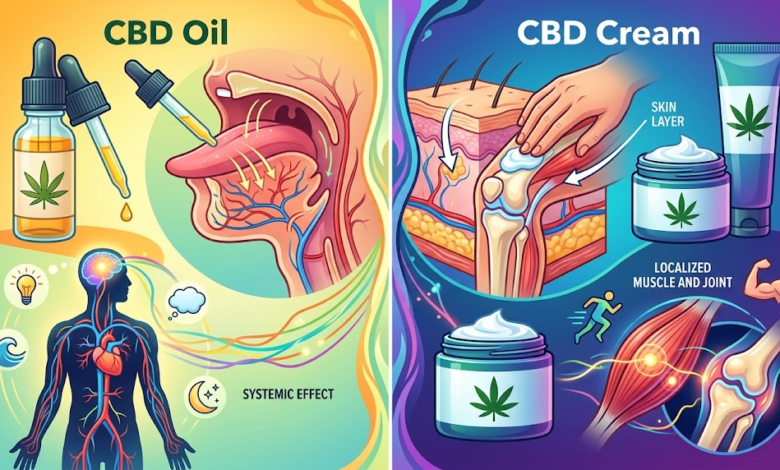
CBD oil is typically taken by mouth or under the tongue, moves through your bloodstream, and can affect your whole system. CBD cream stays on the surface, working locally on the skin and the tissue just beneath it. Neither one is automatically “better.” The right choice depends on what you’re actually trying to fix, how fast you need results, and how much you’re willing to trust a market that, until fairly recently, operated in a legal gray zone with almost no oversight.
This article breaks down the real differences between CBD oil and CBD cream, walks through the messy legal history that still shapes product quality today, and gives you a practical way to decide which one fits your situation.
What Is CBD Oil?
CBD oil is a liquid extract made by pulling cannabidiol out of the hemp plant and mixing it with a carrier oil, usually MCT (coconut-derived) oil, hemp seed oil, or olive oil. It’s sold in small dropper bottles and used in a few common ways:
- Sublingual use – a few drops held under the tongue for 30 to 60 seconds before swallowing, which allows some CBD to absorb directly through the tissue in your mouth
- Swallowed with food or drink – added to coffee, smoothies, or taken straight, which routes it through the digestive system
- Capsules or softgels – a pre-measured, mess-free version of the same oil
Because CBD oil enters your bloodstream, its effects tend to be broader. People use it for general anxiety, sleep trouble, and diffuse pain that isn’t tied to one specific spot on the body. It usually comes in different strengths, and many brands offer full-spectrum, broad-spectrum, or CBD isolate versions. Full-spectrum products contain trace amounts of THC along with other cannabinoids and terpenes, which some researchers believe work together through what’s called the entourage effect, though the science on this is still developing.
What Is CBD Cream?
CBD cream (sometimes called a balm, salve, or topical) is applied directly to the skin over the area that hurts. It’s formulated with CBD suspended in a lotion or ointment base, often combined with other ingredients like menthol, arnica, or capsaicin to boost the sensation of relief.
Unlike CBD oil, cream generally does not enter your bloodstream in meaningful amounts. It interacts with cannabinoid receptors in the skin and surrounding tissue, which is why it’s most popular for:

- Sore muscles after exercise
- Joint stiffness from arthritis
- Localized back or neck pain
- Minor skin irritation
If you’ve got a bad knee or a stiff shoulder, a cream lets you target that exact spot without affecting your mood, appetite, or energy level the way an oral product might.
CBD Oil vs CBD Cream: The Core Differences
Here’s where the comparison actually matters. The two products aren’t interchangeable, and understanding why comes down to a handful of practical factors.
1. Absorption and Onset Time
CBD oil taken sublingually usually starts working within 15 to 45 minutes, since it bypasses some of the digestive process. Swallowed oil or capsules take longer, often 60 to 90 minutes, because they have to pass through the liver first.
CBD cream works faster on the surface, sometimes within 15 to 20 minutes for mild discomfort, but it stays localized. It won’t reach your bloodstream in any significant way, which is actually the point if you only want relief in one area.
2. Duration of Effects
Oral CBD oil tends to last longer in the system, often 4 to 6 hours, because it’s metabolized gradually. Topical cream wears off faster, usually within 2 to 4 hours, and needs to be reapplied more often for ongoing relief.
3. Best Use Cases
| Situation | Better Option |
|---|---|
| General anxiety or restlessness | CBD oil |
| Trouble sleeping | CBD oil |
| Sore muscle after a workout | CBD cream |
| Arthritis in one joint | CBD cream |
| Whole-body discomfort | CBD oil |
| Skin irritation or eczema-adjacent dryness | CBD cream |
4. Drug Test Considerations
This one matters more than people expect. Full-spectrum CBD oil contains trace THC, and with regular use, that can occasionally show up on a sensitive drug test. CBD cream, because it isn’t absorbed into the bloodstream, carries essentially no risk of a positive result. If you’re subject to workplace testing, this is a real practical difference, not a minor detail.
A Brief, Honest Look at CBD’s Legal History
To really understand why product quality varies so wildly between brands, it helps to know where this industry came from, because it wasn’t always legal, and the aftereffects of that are still showing up on store shelves.
Before 2018, hemp itself was federally classified alongside marijuana, and CBD products existed in a genuine legal gray area. Stores in several states, including Texas and Oklahoma, faced raids and product seizures even when the CBD they sold contained no meaningful THC. People selling CBD oil out of storefronts sometimes did so not knowing whether they’d face charges, because enforcement was inconsistent and state laws contradicted federal ones.
The 2018 Farm Bill changed that by legalizing hemp containing less than 0.3% THC, which opened the floodgates for the CBD industry we see today. But legalization didn’t come with strong quality controls. In the years right after, the FDA sent repeated warning letters to companies making unproven claims that CBD could treat cancer, Alzheimer’s, or opioid addiction, none of which had any solid clinical backing.
Independent lab testing during that same period turned up serious mislabeling problems. Multiple studies found that a large share of CBD products on the market either contained far less CBD than the label claimed or contained detectable THC in amounts the label never disclosed, sometimes enough to trigger a failed drug test for someone who had no idea they were at risk. Some products sold as “CBD” were later found to contain synthetic cannabinoids that had nothing to do with hemp at all, a problem that echoed the synthetic marijuana (“K2” or “spice”) scares from years earlier, where unregulated products caused real hospitalizations.
The regulatory picture is still shifting even now. The FDA has continued adjusting its enforcement approach into 2026, and legislation passed in late 2025 narrowed the federal definition of hemp itself, a change set to take effect in November 2026 that could push a meaningful share of currently legal CBD products out of that definition entirely. In other words, the legal ground under this industry hasn’t fully settled, and buying from a careless brand today carries some of the same risk it did a decade ago, just with better packaging.
Quality and Safety Risks in an Unregulated Market
Because CBD still isn’t regulated the way prescription drugs or even standard supplements are, the burden of checking quality falls largely on the buyer. Before choosing between CBD oil or CBD cream, look for:
- A Certificate of Analysis (COA) from an independent, third-party lab, not one owned by the manufacturer
- THC content clearly listed, especially if you’re subject to drug testing
- A batch number that matches the COA you’re looking at, since companies sometimes post an old or unrelated test
- No unproven medical claims on the label or website, since legitimate brands generally avoid language suggesting CBD cures or treats specific diseases
- A U.S.-grown hemp source, since imported hemp has historically had less consistent oversight on pesticide and heavy metal content
Research supported by the National Center for Complementary and Integrative Health continues to study CBD’s effects, but the agency has also been candid that clinical evidence hasn’t caught up with how widely these products are already being used. That gap is exactly why quality control on your end still matters so much.
Which Should You Choose? A Practical Decision Guide
Rather than picking based on marketing, work through these questions:
- Is your discomfort localized to one area, like a knee or shoulder? Choose CBD cream.
- Are you dealing with something systemic, like anxiety, poor sleep, or full-body inflammation? Choose CBD oil.
- Do you need fast, targeted relief without any risk of a positive drug test? Choose CBD cream.
- Are you comfortable with a slower onset in exchange for longer-lasting, whole-body effects? Choose CBD oil.
- Do you want both? Plenty of people use CBD oil daily for general wellness and keep a CBD cream on hand for flare-ups. There’s no rule against combining them.
How to Buy CBD Oil or Cream Safely
- Start with the COA. If a brand can’t produce one easily, move on.
- Check the THC percentage, particularly for oil, and confirm it’s within the legal 0.3% threshold or lower if you need to avoid THC entirely.
- Buy from a company that’s been operating for a few years with a visible customer track record, rather than a brand-new listing with no reviews.
- Start with a low dose for either product and adjust gradually. More isn’t automatically better, and higher doses raise the cost of any quality problem you didn’t catch.
- Talk to a doctor first if you’re on other medications, since CBD can interact with certain prescriptions, particularly blood thinners.
Conclusion
Choosing between CBD oil and CBD cream really comes down to matching the product to the problem: oil for broader, systemic effects like anxiety or sleep trouble, and cream for targeted relief on a specific joint or muscle. Both can be useful, and many people end up using both depending on the day. What matters just as much as the format, though, is where you buy it from. CBD’s legal history is full of unregulated products, mislabeled potency, and companies making claims they couldn’t back up, and while the market has matured, that history hasn’t fully disappeared, especially with new hemp regulations taking effect through 2026. A little diligence, checking lab results, THC content, and where the hemp was grown, goes a long way toward making sure the product you choose actually does what it says.